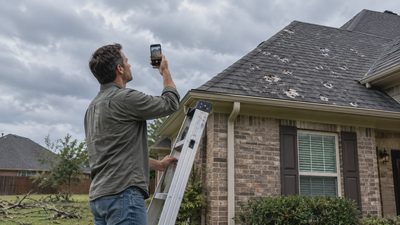
After a hail storm, the timeline feels simple in the first week: the adjuster comes out, the claim gets approved, and the money shows up. Then the contractor's quote arrives, and the check does not match it. If you are staring at a settlement that covers part of the roof and wondering how to cover the rest, you are not alone — this is one of the most common conversations I had during my years as a home improvement financing advisor, and it happens after nearly every serious hail event in Texas. The gap between what insurance paid and what the roof costs is normal, explainable, and usually manageable. This article walks through why the gap appears and what your options are — including insurance claim roof financing to cover the difference while your claim finishes processing.
Why the Check Rarely Matches the Contractor's Quote
The check from your insurer is not a random number. It is the product of a few specific calculations, and each one can create distance between what the insurer paid and what the contractor needs to finish the job. Understanding those calculations is the first step, because each cause of the gap has its own solution. When I helped homeowners sort through these numbers, the ones who understood why the gap existed always felt calmer than the ones who thought the insurance company had simply shorted them.
Actual cash value vs. replacement cost: the depreciation holdback
Your policy may promise replacement cost, but most homeowners are first paid on an actual cash value (ACV) basis — replacement cost minus depreciation. The insurer withholds the depreciated portion until the roof is actually replaced, then releases it after the work is done and the paperwork is filed. That holdback is not a denial; it is money the insurance company is waiting to pay. The gap it creates is temporary, but it is real, and it lands on you at exactly the moment the contractor needs to be paid.
Your deductible comes out of the settlement
Your deductible is subtracted from the claim payment, which means part of the gap is simply the deductible you chose when you bought the policy. If your roof is insured at replacement cost and your deductible is a few thousand dollars, that money is yours to cover out of pocket — or to finance, in some cases, alongside the rest of the project. Knowing your deductible number before you call a contractor is the cheapest way to avoid surprises later.
Items the policy does not cover, and supplements still in the pipeline
Two more common sources of the gap: items the policy never covered, and items the contractor found that have not been approved yet. Decking that needs replacing, code-required upgrades, or work the adjuster did not include in the original estimate often arrive as supplements — additional claims the contractor files with photos and line items after the work begins. Until the adjuster approves them, the money is not in the settlement. Meanwhile, excluded items may simply never be covered, and that portion of the bill is yours.
Common shortfall causes and what covers each
Why the gap exists | What typically covers it |
|---|---|
Depreciation holdback (ACV vs. replacement cost) | Released after the roof is completed and documents are submitted |
Your deductible, subtracted from the settlement | Paid by you; some homeowners finance it with the rest of the job |
Code upgrades and uncovered decking repairs | Filed as a supplement and paid after adjuster approval, or paid out of pocket if excluded |
Supplements not yet approved | Paid after the adjuster signs off; delays are common in storm season |
Items excluded by your policy | Out of pocket, or covered by financing if you choose to proceed |

A Texas Hail Scenario, Step by Step
Let's walk through a realistic example so the numbers feel concrete. Everything below uses round figures for illustration only — your actual numbers will come from your own quote, policy, and adjuster. Here is how a gap typically appears after a hail claim.
The contractor's written quote for the full replacement comes to $26,000.
Your policy covers replacement cost, with a 5,000.
The insurer's initial settlement pays actual cash value minus the deductible: roughly $18,500.
To finish the roof, the contractor needs the full 7,500 before the holdback and any approved supplements are released.
As the work is completed, the contractor files the final paperwork, the insurer releases the $5,000 depreciation holdback, and an approved supplement for code upgrades adds more — but those payments arrive after the work is done, not before.
In this scenario, the homeowner is not short 7,500 for a season — the weeks between when the contractor needs to order materials and when the insurance money finishes moving. That timing gap is the real problem, and it is a problem with real solutions.

Your Options While the Claim Finishes Processing
Once you can name the gap, you can choose how to cross it. The right answer depends on how fast the claim is moving, how urgent the roof leak is, and what your budget can carry. In my advising years, I watched homeowners use every one of these paths successfully, and the key was matching the option to the timing.
Push the claim forward: supplements and the depreciation release
The first option is not financing at all — it is paperwork. Ask your contractor to file supplements as soon as they are discovered, keep every receipt and photo, and confirm with your adjuster what documents are needed to release the depreciation holdback. A responsive contractor who files supplements quickly can shrink the gap and the wait. This does not always work fast enough, especially in storm season when adjusters are swamped, but it costs nothing to try while you weigh the other options.
Bridge the timing gap with insurance claim roof financing
If the roof needs to move now, insurance claim roof financing can carry the difference while the claim finishes processing. The idea is straightforward: you finance the portion of the project that insurance has not paid yet, then pay down the loan when the holdback and approved supplements arrive. Some of these are the same kinds of roof loans described elsewhere on this site — contractor-offered plans, personal loans, or home equity options — sized to the gap rather than to the whole roof. Hail damage roof financing, as it is sometimes marketed after storm season, is the same family of products: a bridge between the settlement you have and the money you are still owed. The math worth checking, as always, is the monthly payment and the total cost of carrying that bridge for the weeks or months you need it.
Time the job around the check, when you can
If the roof is not actively leaking and the claim is moving steadily, the least expensive option is often patience. Let the contractor schedule around the insurance timeline, do the work when the supplement is approved, and pay the balance when the money arrives. This does not work for every homeowner — sometimes the roof cannot wait — but when it does work, it costs no interest at all.
Keep a Storm Folder: What to Save
Every gap is easier to close when the paperwork is in one place. After my own hail claim, I kept a physical folder in the desk drawer, and it made every phone call shorter. A storm folder does not need to be fancy — it needs to be complete.
The adjuster's report and the insurer's written estimate, including line items.
Photos of the damage, taken before any work begins.
The contractor's itemized written quote, matching the scope of the estimate.
Your signed contract and any permits, plus the claim number and adjuster's contact.
Records of every call and email about the claim, with dates.
When the check covers part of the roof and the contractor is waiting on the rest, that folder is your leverage and your peace of mind. And when you do decide to bridge the gap with financing, lay the loan terms next to the claim documents and read them together — the payment should make sense against the money you know is coming, not against hope. Before you sign, make the payment make sense. If the numbers hold up against the real claim timeline, you can sign with confidence. If they do not, wait, negotiate, or shop the financing — the roof will still be there.