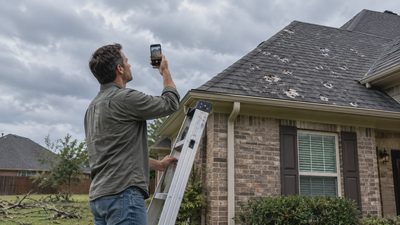

After a hail storm rolls through Plano, everybody on the street checks the same thing: gutters full of pellets, dents in the mailbox, and shingles that suddenly look tired. Then the adjuster comes, the claim gets approved, and homeowners finally meet the number they forgot about — the deductible. Roof insurance deductible financing is one of the least discussed but most practical tools in storm season, because the deductible is usually the first dollar you are responsible for out of pocket, and it is bigger than most people budget for. I have watched families celebrate a full roof approval, then do the math and realize they still owe a four-figure share before a single shingle goes on. Understanding how your deductible works is the difference between a smooth claim and a spring of surprises.
How Your Deductible Works After a Storm Claim
The deductible is your agreed share of a covered loss, and on a roof claim it comes straight out of the insurance payment. It is not an extra bill the contractor adds — it is the portion of the repair cost that your policy expects you to carry, subtracted from what the insurer pays.
Flat-Dollar vs. Percentage Deductibles
There are two common ways policies structure roof deductibles, and the difference matters in Texas. A flat-dollar deductible is a set amount, such as 2,500, that you cover on any approved claim. A percentage deductible is a share of your home's dwelling coverage, and hurricane and hail deductibles written as percentages are common in Texas wind and hail policies. If your dwelling coverage is 3,000 — not $500. Homeowners who never read that page of the policy are the ones who get the rudest surprise at settlement time.
The Math That Runs Every Roof Claim
Keep this equation in your head and you will never be blindsided again: the contractor's price minus the insurance payment equals your share, and your share starts with the deductible. If the claim is approved at the full contractor price, your out-of-pocket cost is exactly the deductible. If the insurer settles for less than the full price — a partial approval, depreciation not yet recovered, or a supplement still pending — your share grows beyond the deductible to cover the gap between what the insurance paid and what the roofer actually charges.

What Your Deductible Actually Leaves You to Cover
The fastest way to feel this is on paper. Take a $16,000 roof repair that is approved at full replacement value and run it at a few common deductible levels. These are illustrative numbers to show the pattern; your actual deductible comes from your own policy.
Deductible structure (illustrative) | Insurance pays (approx.) | Your out-of-pocket share |
|---|---|---|
Flat $1,000 deductible | about $15,000 | $1,000 |
Flat $2,500 deductible | about $13,500 | $2,500 |
1% of a $300,000 dwelling | about $13,000 | $3,000 |
2% of a $300,000 dwelling | about $10,000 | $6,000 |
Two things jump out of that table. First, the deductible is not pocket change — at common Texas levels it is often more than a family has sitting in checking after the holidays. Second, a percentage deductible on a home with high dwelling coverage can leave you covering thousands more than the "$500 deductible" you thought you had. This is the exact moment roof insurance deductible financing earns its place, because it lets you cover that fixed share with a payment plan instead of draining your emergency fund. Programs in this category — sometimes marketed as hail damage roof financing — are really just loans sized to your storm loss, which means they deserve the same APR-and-term review as any other loan.
The Real Options for Covering Your Share
You have more ways to handle the deductible than most contractors will mention, and they are worth comparing like any other purchase:
Roof insurance deductible financing: a loan sized to your deductible or to the gap between the insurance payment and the contractor's price, paid back over a set term. Some financing partners set this up alongside the roof estimate.
A personal loan or credit union line of credit: useful when you want to keep the roofing company out of the lending conversation entirely.
A home equity line if you have one: can carry a lower rate, but it is secured by your home, so it deserves the same caution as any home-secured debt.
Paying cash and rebuilding the fund slowly: the cheapest option if the number is small enough to absorb.
Asking your insurer about payment plans on the premium side so a higher premium does not create a new hole in the budget.
The Caution About Deductible "Waivers" You Need to Hear
Now the warning, stated calmly because it needs to be stated clearly. In many states, including Texas, it is illegal for a contractor to pay, waive, or absorb your insurance deductible, and a "we'll cover your deductible" offer is usually claim fraud — the discount has to show up somewhere, and it typically shows up as inflated pricing on the paperwork, reduced work quality, or a claim that does not survive review. Do not take that deal. A contractor who builds your deductible into a padded bid has committed you to a crime you did not mean to commit, and if the fraud is discovered later, it lands on the homeowner's policy too.

Questions to Ask Before You Borrow for a Deductible
If you decide to finance your deductible, ask the same questions you would ask about financing the whole roof, because it is the same kind of decision:
Is this loan unsecured, or is there a UCC filing or lien tied to my home?
What is the APR, the term, and the total of payments on the actual document?
Does the payment plan reset or balloon if the insurance claim changes after the work starts?
Can I pay it off early without a penalty when my insurance settlement or tax refund lands?
The Deductible Is Part of the Roof's Real Price
Here is the honest way to think about storm season: the deductible is not a paperwork nuisance, it is part of the real price of the roof, and pretending otherwise is how families end up surprised at the end of a claim. When hail season hits and neighbors are comparing roof quotes in the driveway, the smart ones are comparing deductibles too — what the policy says, what the contractor's price implies, and what their own budget can cover. My house numbers spreadsheet has a line for every big repair, and the storm-deductible line is always filled in before the adjuster even arrives. Plan for the deductible the way you plan for the roof itself, price your financing options honestly — including roof insurance deductible financing if that fits your budget — and skip any contractor who offers to make your deductible disappear. Before you sign, make the payment make sense.