
I spent more than a decade as a home improvement financing advisor, and the question I heard most often in Plano driveways wasn't about shingles — it was the quieter one that comes after the hail estimate lands: "My credit is okay, not great. Can I even finance a roof?" The straight answer about roof financing with fair credit is yes, and homeowners do it every storm season. What fair credit changes is not whether a door opens; it changes which doors open, what rate ends up on the offer, and how carefully you should read before you sign. Fair credit is a middle-of-the-road starting point, and middle-of-the-road terms deserve middle-of-the-road scrutiny.
What "Fair Credit" Means When a Lender Looks at You
Here's the thing I learned after years of sitting next to homeowners while they stared at financing screens: lenders don't think about credit the way we talk about it across the fence. They sort applicants into tiers, and the tier you land in decides which options you see before you ever speak to a loan officer. Fair credit sits somewhere around the middle of that spectrum. It's not the tier that gets the headline rate in the mailer, and it's not the tier that gets a fast "no." It's the tier that gets approved — usually — but on terms that punish you if you stop comparing. Most of the homeowners I helped were in exactly this spot, and the ones who did well had one habit in common: they shopped the total cost instead of trusting the first number put in front of them.
How Lenders Tier Borrowers
No two lenders draw the lines in the same place, so think of this table as a rough map rather than a rulebook. The shape is what matters: as credit standing improves, illustrative rates tend to edge down and the number of offers tends to go up. I've written these rows as general impressions from real conversations, not as any lender's actual rate sheet.
Credit standing (general) | What you might be offered (illustrative) | What it means for you |
|---|---|---|
Strong credit | More choices, lower advertised rates | You can negotiate on rate and term |
Fair credit | Mid-range rates, fewer zero-interest promos, some fees | Compare total cost, not just the monthly pitch |
Weaker credit | Higher rates, smaller approval amounts, more fees | Read every disclosure line and slow down |
The difference of even a couple of points on a roof-sized balance is real money, not pocket change. On $15,000 borrowed over five years, for example, a higher illustrative rate can push the total interest well past a thousand dollars. That's why I tell homeowners in the fair tier to shop the total of payments, not the number the salesperson repeats first.
Where Roof Financing With Fair Credit Gets Realistic
Let me be plain about what a homeowner in the middle of the credit spectrum should expect, because a realistic read on roof financing with fair credit looks like this: you will likely have options, your rate will probably sit higher than the flashy advertised numbers, and a couple of those "convenient" offers will quietly be expensive. None of that means no roof. It means the terms deserve extra scrutiny.
Personal Loans: Higher Illustrative Rates, More Control
A personal loan is the route where you borrow the money yourself and the roofer gets paid in full. When you line up roof financing with fair credit, personal loans often show up first because they don't depend on the contractor's financing desk. Expect the lender to quote a higher rate than the specials you see in ads, because you're not in the tier those specials are built for. The tradeoff is control: one fixed payment, a set term, and a lender you can call directly if something looks off. If a local credit union will work with you, that's often a steadier number than whatever the contractor's screen displays.
Contractor Financing: Convenient, but Read the Engine
Most roofers in Texas work with a partner lender, and that convenience is real — one office, one signature, roof on by Friday. The catch is that those roof loans get priced by the same credit tiers as anything else, so with fair credit you may see a shorter term, a higher rate, or a fee folded into the balance. Always ask for the APR and the total of payments in writing before you nod along. If the rep can't produce them on the spot, that hesitation tells you something.
Offers to Walk Past
A few phrases should slow you down instead of speeding you up. "No credit check" financing almost always buries its cost somewhere — in a fee, in a rate, or in a short term that balloons on you. Store-style single-payment plans run on the same logic: the longer you take, the more the plan earns. If an offer can't show you the APR and the total of payments in writing, treat that refusal as your answer. Before you sign, make the payment make sense.

What a Cosigner or a Few Months of Cleanup Can Change
Two levers move your numbers more than people expect. A cosigner with stronger credit can pull an application into a higher tier, and a better tier usually means a lower illustrative rate — which matters over sixty months of payments. A few months of cleanup can do similar work: pay down credit card balances, dispute a stale error on your report, keep every bill current. Nobody can promise a specific rate, and you should treat any promise of that kind with suspicion. But it's worth asking a lender, "If I come back in ninety days, do my numbers look different?" Sometimes the roof can't wait. Sometimes a tarp, a plan, and ninety days are the cheapest fix available.
Five Moves to Make Before You Apply
Treat a financing application like an estimate: gather your papers before anyone starts talking numbers.
Pull your own credit report and check for errors, because roof loans are priced on what that report says — a mistake there costs you every single month.
Write down the full roof cost, including materials, labor, the permit, and any insurance deductible you're covering out of pocket.
Compare at least two routes: the contractor's partner lender and a local credit union or bank.
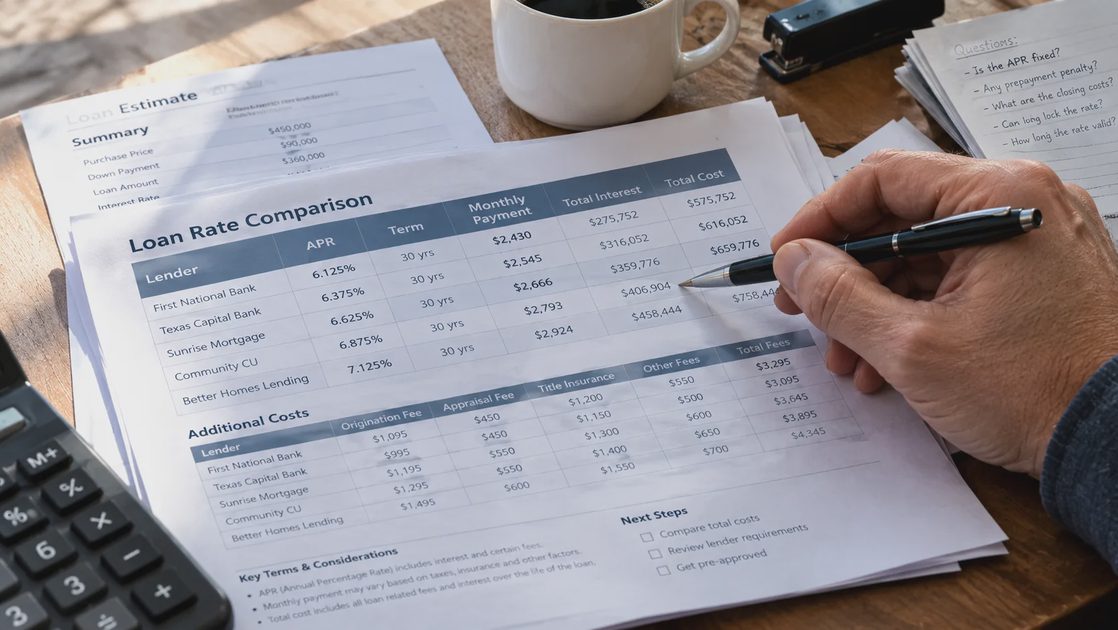
Ask each lender to put the APR, the term, and the total of payments in writing before you decide anything.
Compare the totals side by side, not just the monthly figure each pitch leads with.
The Bottom Line for Fair-Credit Borrowers
Fair credit is a starting point, not a sentence. Homeowners in the middle of the credit spectrum finance roofs every season; they just have to be willing to do the math themselves. Know the total cost, know the rate, and know what a late payment does to both. If an offer can't survive being written down and compared, walk away. And when two offers both look workable, take the one whose numbers you understand completely — because in my book, understanding the deal is half the value of the deal.