
Most roof questions start with the same words: "What would the payment be?" And that is exactly the question a roof payment calculator is built to answer. Depending on the size and pitch of your house, the material you choose, and whether the old roof has to be torn off first, a full replacement can land in a wide range — so in this article we are going to work through three of the price points I heard most often in my years around Texas roofing jobs: roughly 18,000, and $25,000. For each one, we will look at the monthly payment, the loan term, and the number too many people skip: what the roof actually costs you after every payment is made. I will keep every figure clearly labeled as an example, because your quote, your credit, and your market will set your real numbers.
Three Roof Price Points a Texas Homeowner Might Face
Roof prices vary with the house, so think of these three totals as starting places rather than predictions. I am using round numbers because they make the math easy to follow, and because they sit in the range I heard over and over in quotes across Plano and the surrounding area.
A roughly $12,000 roof: the kind of total a smaller house or a basic three-tab replacement on a modest roof might reach, including tear-off and standard materials.
A roughly $18,000 roof: a more typical full replacement for a mid-size suburban home, often with architectural shingles and a couple of small decking repairs.
A roughly $25,000 roof: a larger or steeper roof, or one with upgrades like premium shingles, ice-and-water shield, or significant plywood replacement.
These are illustrations, not price lists. What matters for the rest of this article is not the exact totals but how the payment math behaves as the amount grows and the term stretches.
What a Roof Payment Calculator Actually Does
A roof payment calculator takes three inputs — the amount financed, the APR, and the loan term in months — and returns the monthly payment, plus usually the total cost of the loan. The trick is that the monthly payment is the only output most people remember. A roof loan calculator and a roof payment calculator do the same math; they just present it a little differently. If you understand the three inputs, you can sanity-check any lender's quote, and you can spot when a payment number has been built on assumptions that do not match what you were told.
A quick anchor for checking the math by hand
Before you touch any tool, here is the anchor I used for years. These are approximations, good enough to catch a misleading number:
At roughly 7% APR over 60 months, every 20 per month.
At roughly 7% APR over 120 months, every 12 per month.
So 356 a month — about $20 times 18.
Rates move with the market and your credit, so treat any rate as an example, not a promise. The point of the anchor is that you can do the math on a napkin and notice if the quote you are handed is built on a very different rate than the one you were told about.
What 18,000, and $25,000 look like across terms
The table below shows illustrative monthly payments at two sample rates and two common terms. Rates of about 7% and about 10% are used as examples to show how sensitive the payment is to the rate, not as quotes. Every figure is a rounded estimate.
Amount financed | 60 months, ~7% APR | 60 months, ~10% APR | 120 months, ~7% APR | 120 months, ~10% APR |
|---|---|---|---|---|
$12,000 | roughly $240/mo | roughly $255/mo | roughly $144/mo | roughly $159/mo |
$18,000 | roughly $356/mo | roughly $383/mo | roughly $216/mo | roughly $238/mo |
$25,000 | roughly $500/mo | roughly $531/mo | roughly $300/mo | roughly $330/mo |
Notice how the rate moves the payment far less than the term does. Dropping from 60 to 120 months cuts the payment by roughly a third of the way to half. That is why the term is the dial that sales pitches love to turn.
Why the Term Choice Matters More Than the Rate
If the payment is the only number you look at, a 120-month term looks like a gift. But the term is also what decides how much interest you pay over the life of the loan, and that is where the real cost hides. A longer term does not make the roof cheaper — it makes the monthly bill lighter while making the total bill heavier. Consider these points before you let a low payment decide for you:
A shorter term means a higher monthly payment but less total interest, so the roof is paid off sooner and you keep more of your money over time.
A longer term means a lower monthly payment that fits a tighter budget, but you pay interest for more years and the total cost climbs.
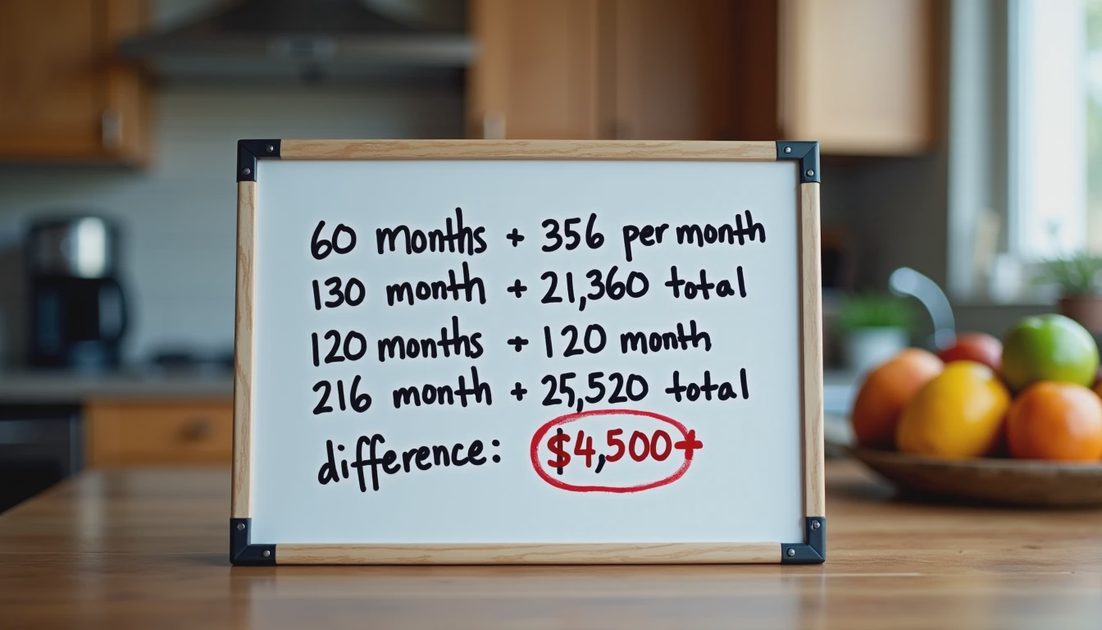
The difference between 60 and 120 months on 4,500 of extra interest — more than $4,500 that could have gone to a future repair or a college fund.
Promotional loans sometimes tie a very low rate to a shorter term; read whether the rate changes if you take the longer term instead.
The right term is the one your budget can genuinely carry, not the one that makes the sales flyer look friendlier.
The Payment Is Only Half the Story
Here is the part a roof payment calculator will happily show you if you scroll for it, and the part that gets skipped when a contractor just reads out a monthly number: the total cost. Let's put the 356 a month and the total comes to about 216 a month, but the total climbs to about 4,500 of difference — that is the price of the lower payment.
The longer term is not automatically a mistake. If 216 fits comfortably, the longer loan may be the honest choice, especially if it protects you from missing payments. What I have never seen work well is the reverse: choosing a term by accident, because the payment was the only number anyone showed you. Every homeowner deserves to see both numbers — the monthly cost and the total cost — before choosing.
The Bottom Line on Roof Payments
A roof payment calculator is a good starting point, but it only helps if you use all of its outputs. The monthly payment tells you whether you can live with the loan; the total cost tells you what the loan is actually charging you for the privilege. When you compare options for your next roof, write down four numbers for each offer: the amount financed, the APR, the monthly payment, and the total cost. Put them in a column on your own paper and let them argue with each other.
That is how I handled my own roof after hail season, and it is how I would handle yours if we were comparing quotes in the driveway. Before you sign, make the payment make sense. And make sure the number that makes sense to you is the total, not just the monthly one the flyer wanted you to see.