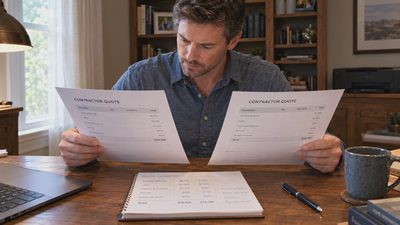
Let me set the scene. A neighbor knocks on my door on a Saturday afternoon, kids are playing in the cul-de-sac, and he is holding a rolled-up estimate and a financing agreement from the roofer who finished the inspection an hour ago. "Does this look right to you?" he asks. That is a question I have answered more times than I can count, in Plano and in the years before that. So I wrote down the checklist I would literally hand him — the same one I would want handed to me before I signed anything. It works for roof loans, contractor plans, personal loans, whatever paper ends up in front of you. Walk through it in order, and you will catch most of the expensive mistakes before they become yours.
Start With the Lender, Not the Shingles
Most people begin by reviewing the roof price because that is the number they understand. Do it the other way around. The financing agreement is a legal product sold by a lender, and you should know who that lender is before you care about shingle color. If the contractor says "we do our own financing," they almost never mean it — there is a finance company behind that statement, and that company is who your payments will go to for the next five years.
Documents to Request Before Anything Else
Ask for these up front, and treat a hesitation to provide them as its own answer:
The lender's legal name, their state lending license number, and a phone number that reaches a human being.
A sample of the actual loan agreement — not a summary page, the real document.
The full payment schedule showing every payment, not just the first one.
The financing company's written disclosure of the APR, the term, and the total of payments.
A copy of anything you sign, on the spot, before you leave the table.

Read the Real Numbers Off the Real Document
The flyer says one thing and the contract says another, and the contract always wins. So ignore what was said out loud and read the numbers that are printed on the page in front of you. This habit matters for roof loans, contractor plans, and everything in between, because the printed page is the only version of the deal that counts. It is also where I see the most heartbreak — and where a calm ten-minute read saves the most money.
The Fine Print Items to Hunt For
Here is a table of the fine-print items I check in every financing agreement, and the one question I ask about each:
Fine-print item | What to look for | The question to ask |
|---|---|---|
APR | The real number, not "the rate" | Does this APR include all fees, and is it the number I was quoted? |
Term | The number of months spelled out | How many months am I actually paying, and what is the last payment date? |
Total of payments | A dollar figure somewhere in the document | Is the total equal to the payment times the number of months? |
Fees added to principal | Origination, documentation, or "administrative" fees | Which fees are rolled into the loan, and could I pay them separately instead? |
Collateral and liens | A UCC filing or a security interest in my home | Is this loan secured by my house or my roof, and what happens if I default? |
Prepayment rules | A prepayment penalty clause | Can I pay the loan off early without a penalty? |
Cancellation rights | A rescission or right-to-cancel window | How many days do I have to cancel, and is it in writing? |
Read each line as if it were the only line on the page. If a number on the document does not match what the contractor said at the kitchen table, the document is the truth and the conversation was the sales pitch.

Work Through the Pre-Sign Checklist in Order
Here is the step-by-step order I would use, and the order I put in front of my neighbor:
Confirm the lender is real. Call the number on the document before you sign and ask for the loan department. A real lender answers.
Confirm the loan amount equals the roof price plus only disclosed fees. If the principal is higher than the quote with no explanation, stop.
Check that there are no blank fields. Any empty space on a contract can be filled in later, and it will not be filled in your favor. If a line is blank, the document is not ready to sign.
Confirm whether the plan is secured. Ask directly: "Is there a lien on my home or a UCC filing on my roof?" A yes is not automatically fatal, but it must be a decision you make with your eyes open.
Find the cancellation rights. Some loans carry a right to cancel within three days. Know the window and use it if you need to keep shopping.
Check the early payoff rule. If you plan to pay the loan off in eighteen months, a prepayment penalty can quietly erase your savings.
Read the total of payments one more time. Before you sign, say the total out loud. If it surprises you, that is the moment to walk away and compare another offer.
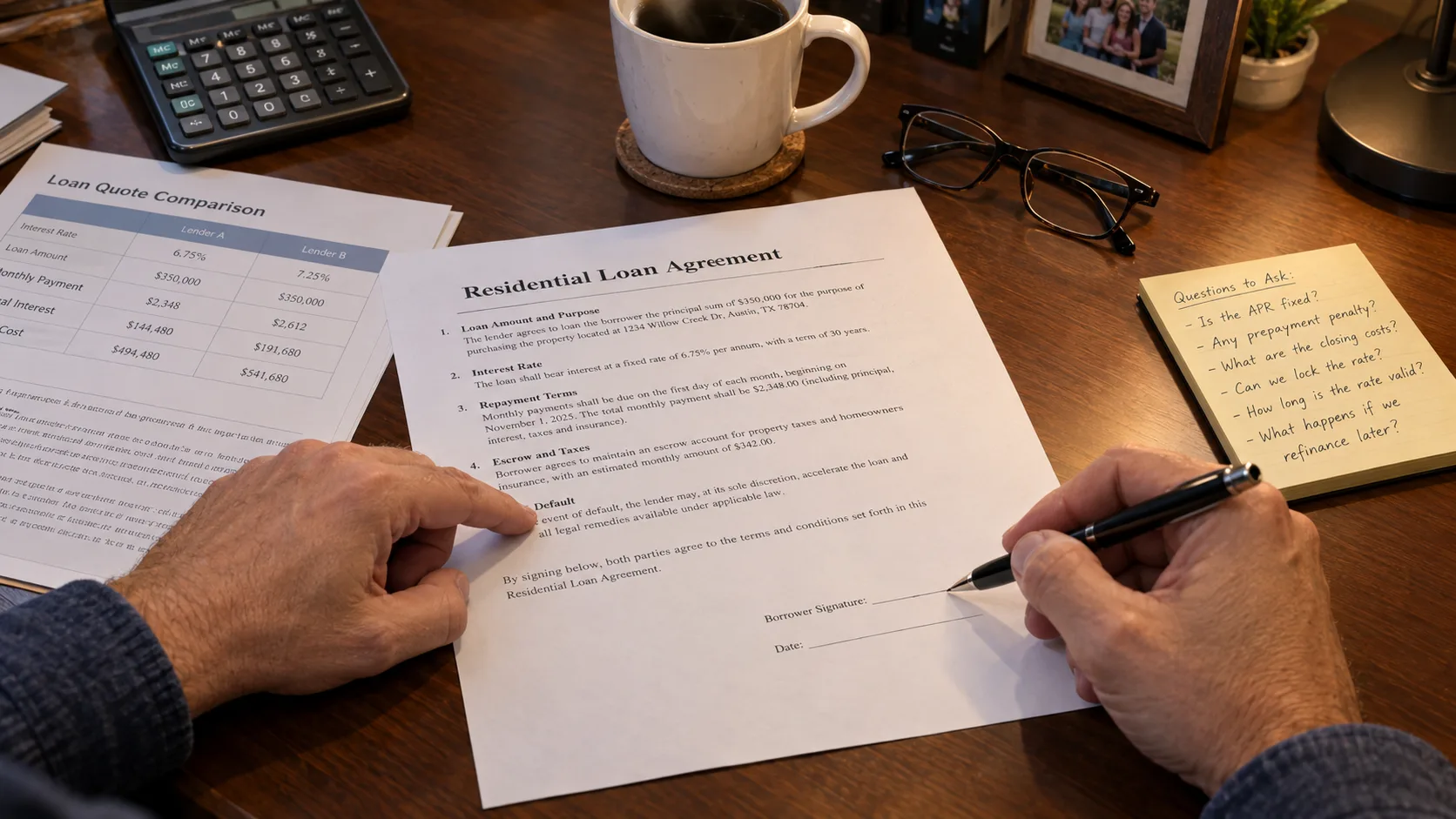
Compare the Paperwork, Not Just the Payment
Here is a piece of advice that has saved my neighbors more money than any single clause on this list: never sign the first financing document you are handed. Take the paperwork home, put it next to the quote from the second contractor, and compare them side by side the way you would compare two bids for the same job. Financing is part of the price of the roof, and you comparison-shop everything else. Roof loans deserve that same comparison-shopping, and so does any contractor plan — nothing about a financing offer improves just because you signed it the same afternoon. The neighbor who waits twenty-four hours and reads the fine print twice is rarely the neighbor who calls me a year later asking whether a lien can be removed. And the single line I repeat most often when someone is hovering over a signature with a pen in hand is the same one every time. Before you sign, make the payment make sense.