
By the time you are holding the pen over a roofing contract, you have already done the hard part: you got multiple quotes, you chose a contractor, and you picked a way to pay. But the final fifteen minutes before you sign matter more than any single hour that came before. In my years advising homeowners on roof loans and contractor payment plans, the worst surprises rarely came from the roof price. They came from the paper. This is the fifteen-minute review I wish every homeowner would run before signing anything, and I will walk you through it minute by minute. It is built for roof loans, contractor payment plans, and any other financing paper a roofer sets in front of you.
Minutes 1–3: Make the Paper Match the Roof
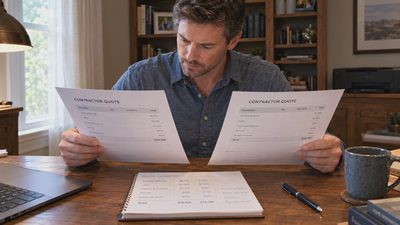
Start with the boring part, because it is where a lot of trouble quietly begins. The roof price on the contract should match the roof price on the quote you agreed to — not close, not "about the same," but the same number. Then check that the scope matches too. The contract should describe the same materials, the same tear-off and disposal, the same flashing work, and the same square footage that the salesperson quoted on your driveway. When the paper does not match the quote, assume the paper wins, because that is the document a court would read if it ever came to that.
The Three Disagreements I See Most Often
In real paperwork, the mismatches are rarely dramatic. They are small: a warranty that changed length between the brochure and the contract, a materials line that says "comparable" instead of the specific shingle you picked, or a line-item charge that appeared after the quote was printed. Each one on its own looks minor. Together, they can shift the total or shrink what you thought you were buying. If a number or a description differs from the quote, get it fixed on the contract before you sign, not after. Get that same discipline whether the deal is a cash contract or one of the roof loans you are comparing — the paper has to match either way.

Minutes 4–6: Follow the Money Line
Now turn to the page that shows the financing. Whether you are looking at roof loans from a lender or a contractor's payment plan, the money line should answer five questions without a calculator: the annual percentage rate, the term in months, the monthly payment, the total of all payments, and the fees included in the amount you are financing. If any of those five is missing, ask for it in writing. A financing page that cannot state the monthly payment clearly is a financing page that has not been finished yet.
The Numbers That Must Match
The easiest way to catch a problem in the money line is to compare the contract against the written quote side by side. Keep in mind that some roof loans include fees in the financed amount, so the total you repay will be higher than the roof price even when the rate is fair. What must match is what you were told, not what you hoped. Bring the quote and the contract to the same table and check these items:
Line Item | Where It Should Appear on the Quote | Where It Must Appear on the Contract |
|---|---|---|
Roof price and total scope | A clear total on the quote you accepted | The same total, with the same scope described |
Annual percentage rate | Stated in the financing offer | Stated on the contract, not just verbally |
Loan term in months | Stated in the financing offer | Stated on the contract |
Monthly payment | Stated in the financing offer | Stated on the contract |
Total of all payments | Disclosed or calculable | Disclosed on the contract |
Fees added to the financed amount | Itemized if disclosed | Itemized so you can see what you repay |
Warranty length and coverage | Described by the salesperson | Written exactly as promised |
Start date and completion window | Discussed before signing | Written so a delay is measurable |

Minutes 7–9: Know Who You Are Borrowing From
Plenty of contractors offer payment plans through a lender partner, and that is normal. What is not normal is signing without knowing which lender you are dealing with. Take three minutes to confirm the lender's full name, confirm it is a real company you can look up, and read the roof financing contract terms the same way you read the roof price. If the contract includes a security interest, a UCC filing, a prepayment penalty, or language that lets the contractor assign the deal to another company later, you need to know that before you sign. The question is simple: "Who am I actually borrowing from, and what rights does this paper give them?"
The Lender Test I Use
If the lender is a company you have never heard of, that is not disqualifying on its own. What matters is whether the company can be found, called, and asked questions before you commit. Try the test: call the customer service number on the financing paperwork and ask how to get a payoff statement. The way that call goes will tell you more than any brochure. That phone call has talked more than one neighbor out of a roof loan that looked fine on paper.
Minutes 10–12: Hunt for Blanks and Verbal Promises
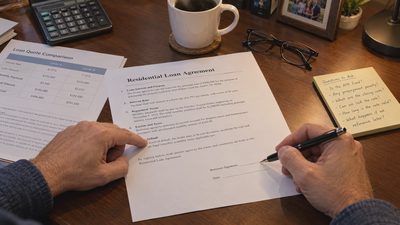
This is the minute block where most of my neighbors find something worth fixing. Scan every page for blanks — empty signature lines, unfilled dates, unmarked checkboxes, and spaces where a number should be. A blank in a contract is an open invitation for someone else to fill it in later, and that someone will not be you. For roof loans, blanks are where the surprises get written in later. Then take every verbal promise you collected during the sales visit and make sure it is written down. "We'll handle the permit" means nothing on a contract that does not mention permits. "The warranty covers that" means nothing if the warranty section says otherwise. If you were told to sign now and read later, that is a reason to slow down, not a reason to speed up.
Minutes 13–15: Photograph Every Page and Ask for Copies
The last three minutes are the cheapest insurance you will ever buy. Take a photo of every page of the contract and the financing paperwork, including the signature page, before you sign anything. Then sign, and ask for your own copies on the spot — not copies that will be emailed later, not "we will send them with the work order." Printed or digital, you want the exact document you signed in your hands before the contractor leaves your driveway. This is also the moment to write the date and the names of everyone present on your copy.
The Fifteen-Minute Routine at a Glance
If the walkthrough above felt like a lot, here is the whole routine on one screen. Print it, keep it by the door, and run it every time:
Minutes 1–3: Match the roof price and scope between the quote and the contract.
Minutes 4–6: Confirm the APR, term, monthly payment, total of payments, and fees in writing.
Minutes 7–9: Verify who the lender is and read the financing terms for security interests and penalties.
Minutes 10–12: Fill or flag every blank, and get every verbal promise written into the contract.
Minutes 13–15: Photograph all pages and take your own copies before the crew starts.
That is fifteen minutes, once, at the kitchen table. It is a small price compared with the cost of discovering a surprise two years into a payment plan.
What This Blog Stands For
I spent over a decade helping homeowners understand roof loans and payment plans for roofing, windows, siding, and storm repairs, and I keep a house-numbers spreadsheet for my own big repairs the same way I keep this advice for you. This blog exists to translate the fine print into plain numbers: total cost, monthly payment, interest, fees, and what happens if you miss something. You do not need to become a financing expert to protect yourself — you need a routine and the nerve to use it. Run the fifteen minutes, ask the questions, and take the copies. Before you sign, make the payment make sense.