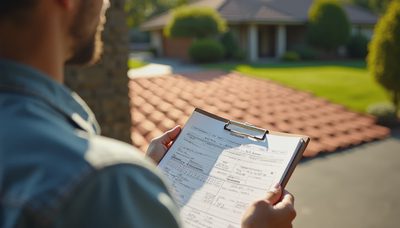

A sample roofing contract is useful because it gives you something concrete to review before a contractor arrives with a tablet and a monthly payment pitch. You can compare the work promised, the price, the deposit, the warranty, and the financing language without feeling rushed. The contract is not just paperwork. It is the written record of what your roofer must do and what you must pay.
I have seen homeowners focus on the shingle color while skipping the payment schedule. That is backwards. A roof can look excellent from the curb and still leave you with a confusing change order, an uncovered insurance gap, or a loan that costs far more than expected. Before you sign, make the payment make sense and make sure the construction details are equally clear.
What a sample roofing contract should identify
Start with the basic project information. The document should name the contractor, business address, phone number, license information when applicable, and proof of insurance. It should also identify the homeowner, property address, expected start date, estimated completion date, and the exact areas of the roof included in the job.
The scope of work deserves the closest reading. A strong sample roofing contract describes tear-off, disposal, deck inspection, underlayment, flashing, drip edge, ventilation, ice and water protection where appropriate, shingles or other roofing material, and cleanup. It should say whether the contractor will replace damaged decking and how that extra work will be priced. “Install new roof” is too vague to protect either side.
Look for product details, not just a manufacturer name. The contract should state the shingle type, color, brand or product line, ventilation components, ridge caps, pipe boots, and metal flashing. If the proposal promises an upgraded architectural shingle but the contract says only “asphalt shingles,” ask for a correction before you put down a deposit.

Read the price and payment schedule line by line
The total contract price should be easy to find. It should show whether sales tax, permit charges, disposal, labor, and materials are included. A reasonable deposit might be a fixed amount or a percentage tied to local practice, but a demand for nearly the entire price before work begins deserves serious questions. Never assume a verbal promise will override a written payment schedule.
A useful sample roofing contract separates the deposit, progress payments, insurance proceeds, and final payment. For example, a $16,000 roof might require $4,000 at signing, $8,000 after materials arrive and work begins, and $4,000 after final cleanup and inspection. If your insurer is expected to pay part of the claim, the contract should explain when those funds are due and whether you remain responsible for any deductible or uncovered amount.
Be careful with phrases such as “balance due upon insurance payment.” That wording does not automatically mean insurance will cover the full bill. If the carrier approves $12,500 and the roof contract is $16,000, you could still owe the $3,500 difference plus your deductible, depending on the policy and the agreement. Get the gap explained in actual dollars.
How financing language changes the deal
Contractor financing can be convenient, but the roof contract and the loan agreement may be separate documents. Read both. A financing offer showing $275 per month does not tell you the total cost, annual percentage rate, term, origination fee, or what happens if a promotional period ends.
Suppose a $15,000 project is financed for 60 months at an APR that produces a payment near $300. The payment sounds manageable, but 60 payments total about $18,000 before any late charges. A longer 84-month term could lower the monthly amount while increasing the total interest. Here is the number I would look at first: the total of all scheduled payments, not the largest font on the sales sheet.
Deferred-interest promotions need special attention. “No interest if paid in full” can mean interest is added under the offer terms if the balance is not fully paid by the deadline. That is different from a true zero-percent loan. Ask who the lender is, whether there is a minimum monthly payment, whether prepayment is allowed without a penalty, and whether financing fees are included in the roof price.

Insurance claims, supplements, and change orders
Storm damage creates another layer of risk. A contractor may find damaged decking, flashing, or ventilation after removing shingles. That work can be legitimate, but it should not become an open-ended bill. The contract should describe the change-order process, including how you approve additional work and whether written approval is required before the contractor proceeds.
If the roof is connected to an insurance claim, keep the estimate, coverage letter, deductible information, and contractor proposal together. An insurer’s estimate is not always the same as the final construction price. A supplement request can add approved line items, but a supplement is not guaranteed money. Do not sign a contract that treats every requested supplement as an approved payment.
A clear clause might say that extra decking costs a stated amount per sheet or square foot after your written approval. A weak clause might say that all hidden damage will be billed at market price. The second version gives you no useful ceiling. If the contractor rushes this part, slow the conversation down.
Warranties, cancellation, and lien protection
Separate workmanship and manufacturer warranties should be described. A manufacturer warranty generally concerns the roofing product, while a workmanship warranty concerns installation. Ask how long each lasts, what maintenance is required, and whether the warranty transfers if you sell the house. A warranty is only helpful if you know who to contact when a problem appears.
The contract should also explain cancellation rights, especially when the agreement is signed at your home or after a storm-related sales visit. Federal and state rules can differ, and some transactions have exceptions, so read the actual notice attached to the contract rather than relying on a sales representative’s summary. Keep a dated copy of every page and attachment.
Ask how the contractor handles payments to suppliers and subcontractors. In some states, unpaid parties can create lien concerns even after a homeowner pays the general contractor. Request conditional or final lien waivers when appropriate and retain receipts. This is a small administrative step that can prevent a large title problem later.
A five-minute contract review before signing
Read the document once for construction and once for money. On the first pass, circle every material, repair, exclusion, cleanup promise, and completion condition. On the second pass, write down the deposit, each payment date, financed amount, APR, total repayment, deductible, possible insurance shortfall, and change-order approval method.
Then compare the written agreement with the estimate and any text messages. If the estimate includes synthetic underlayment but the contract does not, ask which document controls. If the salesperson promised gutters, skylight work, or attic ventilation, those items belong in the signed scope or they should be removed from your expectations.
A sample roofing contract should leave you able to answer three plain questions: What exactly will be built, what is the maximum amount I could owe, and what happens if the project or financing goes wrong? If you cannot answer one of them, the contract is not ready. Take it home, compare another contractor’s terms, and ask for revisions in writing.
The cheapest quote is not always the least expensive roof. A $14,500 proposal with vague exclusions can become more costly than a $16,000 agreement with detailed materials, controlled change orders, and transparent financing. Use the sample roofing contract as a checklist, not as permission to skip professional review. Before you sign, make the payment make sense.